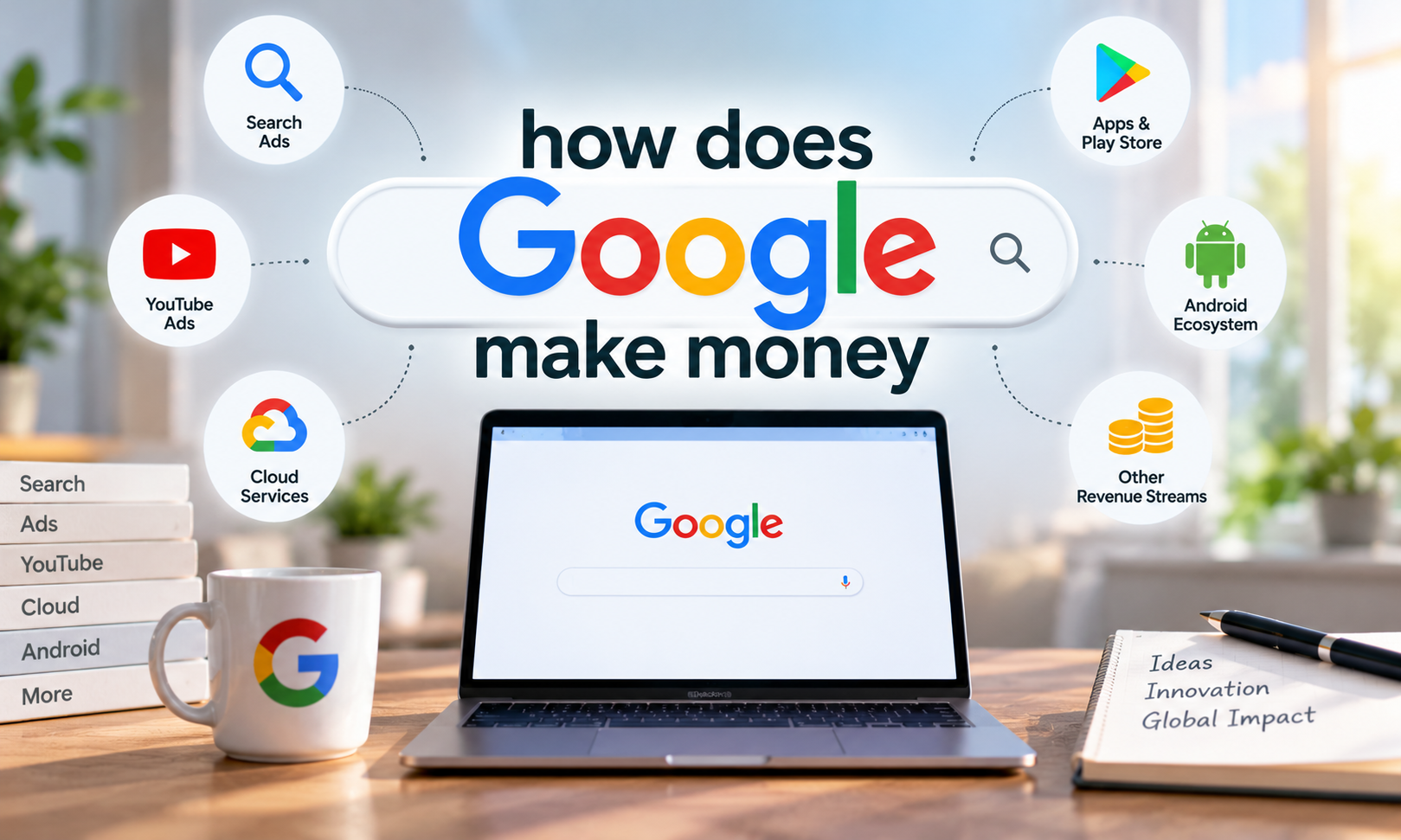
A current 2026 guide to Google’s revenue model, advertising engine, cloud growth, subscriptions, devices, and experimental businesses
If you are wondering how does google make money, the short answer is advertising. Google Search ads, YouTube ads, and ads shown through Google’s partner network still generate the majority of Alphabet’s revenue. However, the company has become much more diversified, with major businesses in cloud computing, Workspace, YouTube subscriptions, Google One, Google Play, Pixel devices, and a collection of experimental companies known as Other Bets.
The old image of Google as a search engine that uses advertising profits to fund unusual projects is still partly accurate, but the financial mix is broader in 2026. Advertising remains the cash engine, while Google Cloud and subscription products are becoming increasingly important growth businesses.
Where Does Google’s Revenue Come From?
| Revenue Source | Q2 2026 Revenue | How Google Earns It |
| Google Search & other ads | $63.3B | Advertisers pay to appear in Search and related Google properties |
| YouTube ads | $11.1B | Video, display, direct-response, and brand advertising |
| Google Network ads | $7.3B | Ads placed on partner websites and properties |
| Subscriptions, Platforms & Devices | $12.9B | YouTube subscriptions, Google One, Play, devices, and platform revenue |
| Google Cloud | $24.8B | Cloud infrastructure, AI services, Workspace, and enterprise subscriptions |
| Other Bets | $382M | Businesses such as Waymo and other early-stage ventures |
Alphabet Q2 2026 figures. Revenue categories do not include hedging adjustments and are rounded.
How Does Google Search Make Money?
Search advertising is still Google’s largest individual revenue source. Businesses bid to show sponsored results when users search for products, services, or information.
Google earns money when advertisers pay for clicks, conversions, impressions, or other campaign objectives, depending on the ad format and campaign type. The business is powerful because Search captures user intent at the exact moment someone is looking for an answer, product, restaurant, flight, insurance quote, or local service.
Alphabet’s Q2 2026 earnings call reported $63.3 billion in Google Search and other advertising revenue for the quarter, up 17% year over year.
Google is also using Gemini across its advertising systems to improve query understanding, ad relevance, and advertiser tools. That matters because generative AI changes the search experience, but Google is trying to make AI-enhanced search commercially useful rather than replacing its ad business.
How Does YouTube Make Money?
YouTube has two major business models: advertising and subscriptions.
Advertisers pay to show video ads, display ads, and direct-response campaigns across YouTube. In Q2 2026, YouTube advertising revenue reached $11.1 billion, up 13% from a year earlier.
YouTube also earns subscription revenue from YouTube Premium, YouTube Music, YouTube TV, and other paid offerings. Those subscription dollars are reported within Google’s subscriptions, platforms, and devices category rather than YouTube advertising.
This combination gives YouTube both ad-supported and paid-user economics, reducing its dependence on a single monetization model.
What Is Google Network Advertising?
Google also places ads on websites and digital properties that it does not own. Publishers can use Google’s advertising tools to monetize their pages, and Google keeps a portion of the advertising revenue.
This category includes revenue from Google Network properties and was $7.3 billion in Q2 2026. Unlike Search and YouTube, Network advertising has recently been flatter, with Q2 revenue down 1% year over year.
That makes Network advertising an important business, but it is no longer one of Google’s fastest-growing areas.
How Does Google Cloud Make Money?
Google Cloud is now one of Alphabet’s biggest growth engines. It sells computing power, storage, databases, cybersecurity, data analytics, AI tools, and collaboration software to businesses and governments.
Google Cloud Platform generally charges customers based on usage, while Google Workspace generates subscription revenue from products such as Gmail, Docs, Drive, Meet, and related enterprise tools.
AI has accelerated this business. Companies pay Google to train and run models, use Gemini and Vertex AI, rent GPUs and TPUs, store data, and operate AI applications.
In Q2 2026, Google Cloud revenue reached $24.8 billion, up 82% year over year. Operating income rose to $8.8 billion, showing that Cloud is no longer only a growth investment but also a major profit contributor.
What Are Subscriptions, Platforms, and Devices?
This category collects several non-advertising Google businesses. It includes YouTube Premium and YouTube Music, Google One subscriptions, Google Play revenue, and sales of hardware such as Pixel devices.
In Q2 2026, the category generated $12.9 billion, up 15% year over year. Alphabet said growth was especially strong in YouTube subscriptions and Google One, helped by demand for AI-related plans.
This is strategically important because recurring subscription revenue makes Google’s consumer business less dependent on advertising cycles.
Does Android Make Money Directly?
Android itself is largely distributed as an operating system platform rather than sold to consumers as a traditional software license.
Google benefits because Android helps distribute Search, Chrome, Google Play, Maps, YouTube, and other services across billions of devices. That ecosystem can generate advertising, app-store, subscription, and service revenue.
Google Play also earns fees from app sales, in-app purchases, subscriptions, and other platform activity.
What Are Alphabet’s Other Bets?
Other Bets contains businesses that sit outside Google’s core services and Cloud segments. The best-known example is Waymo, Alphabet’s autonomous-driving company.
Other Bets generated $382 million of revenue in Q2 2026 but posted a $1.8 billion operating loss, showing why these projects are often described as long-term investments rather than current profit engines.
Alphabet has historically used the enormous cash flow from its core businesses to fund ambitious projects in transportation, life sciences, and other technologies that may take years to become commercially significant.
Why Is Advertising Still So Dominant?
Google owns some of the internet’s highest-intent and highest-traffic properties. Search, YouTube, Maps, Gmail, Chrome, and Android give the company direct access to billions of users.
For advertisers, Google’s advantage is measurement. A business can target a user, show an ad, track a click or conversion, and adjust spending quickly based on performance.
That makes Google’s advertising business extremely scalable. The company does not need to manufacture a physical product for every additional ad it sells, although it spends heavily on data centers, AI infrastructure, traffic acquisition, content, and engineering.
How Is AI Changing Google’s Business Model?
AI is changing where Alphabet spends money and where future revenue may come from. The company is investing heavily in data centers, custom TPUs, GPUs, Gemini models, and AI products across Search, Cloud, Workspace, and consumer subscriptions.
In Q2 2026, Alphabet reported $44.9 billion of capital expenditures, with most of that spending directed toward technical infrastructure for AI.
The business challenge is to make AI improve existing products without weakening the advertising economics that fund the company. So far, Alphabet says AI is supporting both Search ad performance and rapid Cloud growth.
Why Did Google Become Alphabet?
In 2015, Google reorganized under a new parent company called Alphabet. Google remained the largest operating business, while more experimental companies were separated into their own units.
Alphabet’s original restructuring explanation said the goal was to make the company cleaner and more accountable while allowing ambitious projects to operate separately from Google’s core internet businesses.
Today, Alphabet reports Google Services, Google Cloud, and Other Bets as its main operating segments.
Frequently Asked Questions
What is Google’s biggest source of revenue?
Advertising remains Google’s biggest source of revenue, led by Search ads, followed by YouTube advertising and Google Network ads.
Does Google make money from Gmail?
Consumer Gmail is generally free, but Google earns business subscription revenue through Google Workspace, which includes Gmail and other productivity tools.
Does YouTube make more money from ads or subscriptions?
YouTube still generates very large advertising revenue, while paid products such as YouTube Premium, Music, and TV add subscription revenue.
Is Google Cloud profitable?
Yes. Google Cloud reported $8.8 billion in operating income in Q2 2026, with revenue of $24.8 billion.
Does Google make money from Android?
Mostly indirectly. Android supports Google’s services ecosystem, while Google Play, Search, subscriptions, apps, and advertising generate revenue around that ecosystem.
What are Google’s Other Bets?
Other Bets are Alphabet businesses outside Google Services and Google Cloud, including ventures such as Waymo. They currently contribute relatively little revenue compared with Google’s core businesses.
Final Thoughts
Google still makes most of its money the way it has for years: advertising. Search remains the largest engine, YouTube adds another massive ad business, and the Google Network extends advertising across partner properties.
What has changed is the scale of the businesses around advertising. Google Cloud is growing rapidly, subscriptions are becoming more important, and Alphabet continues to fund long-term projects through Other Bets. The modern Google business model is therefore still ad-led, but it is increasingly supported by cloud computing, AI, subscriptions, platforms, and devices.